
“Using foundation models like GPT-4 in healthcare creates a dual compliance challenge: the model itself may be regulated as a general-purpose AI system, while your healthcare application faces h
“Using foundation models like GPT-4 in healthcare creates a dual compliance challenge: the model itself may be regulated as a general-purpose AI system, while your healthcare application faces high-risk classification under the AI Act.” Julie Gabriel, legal lead, eyreACT.
Using foundation models in regulated sectors brings layered compliance risk—you’re not just responsible for your application, but potentially for how you implement the underlying AI model.
Here’s your step-by-step guide to navigating GPT-4 in healthcare applications under EU AI Act requirements.
Step 1: Define Your Healthcare Application
The AI Act’s risk classification depends heavily on your specific use case. The same GPT-4 model can be minimal risk in one application and high-risk in another.
Three Key Healthcare Application Types
Medical Information Chatbot
- Function: Answers general health questions, provides educational content
- Risk Level: Typically Limited Risk (transparency obligations only)
- Example: “What are the symptoms of diabetes?”
Clinical Decision Support
- Function: Assists healthcare professionals in diagnosis or treatment decisions
- Risk Level: Likely High-Risk (Annex III, point 5a)
- Example: Analyzing patient symptoms to suggest differential diagnoses
Direct Patient Diagnosis
- Function: Makes medical diagnoses or treatment recommendations directly to patients
- Risk Level: High-Risk + potential medical device regulation
- Example: “Based on your symptoms, you likely have condition X”
Info: High-risk AI systems in healthcare are those intended to make or influence medical decisions that could impact patient safety or health outcomes.

European AI Act Compliance Course: From Basics to Full Mastery
The EU AI Act is here—and compliance is now a must. This course gives you the tools to turn complex AI regulation into action. Learn the Act’s core principles, risk categories, and obligations, then put them into practice with ready-to-use templates and checklists.
Step 2: Apply the AI Act’s Dual Classification Logic
Understanding GPT-4 in healthcare requires analysing two separate AI systems:
Layer 1: GPT-4 as General-Purpose AI Model (GPAI)
Status: GPT-4 qualifies as a General-Purpose AI Model under Article 3(63)
- OpenAI’s obligations: Model documentation, safety testing, incident reporting
- Your obligations as downstream provider: Due diligence on model capabilities and limitations
Layer 2: Your Healthcare Application
Classification depends on intended purpose:
| Application Type | Risk Category | Key Obligations |
|---|---|---|
| General health information | Limited Risk | Transparency disclosures |
| Clinical decision support | High-Risk | Full EU AI Act compliance |
| Direct patient diagnosis/treatment | High-Risk + MDR | Dual compliance: AI Act + Medical Device Regulation |
Definition: General-Purpose AI Models (GPAI) are foundation models like GPT-4 that can be adapted for multiple downstream applications, creating shared compliance responsibilities.
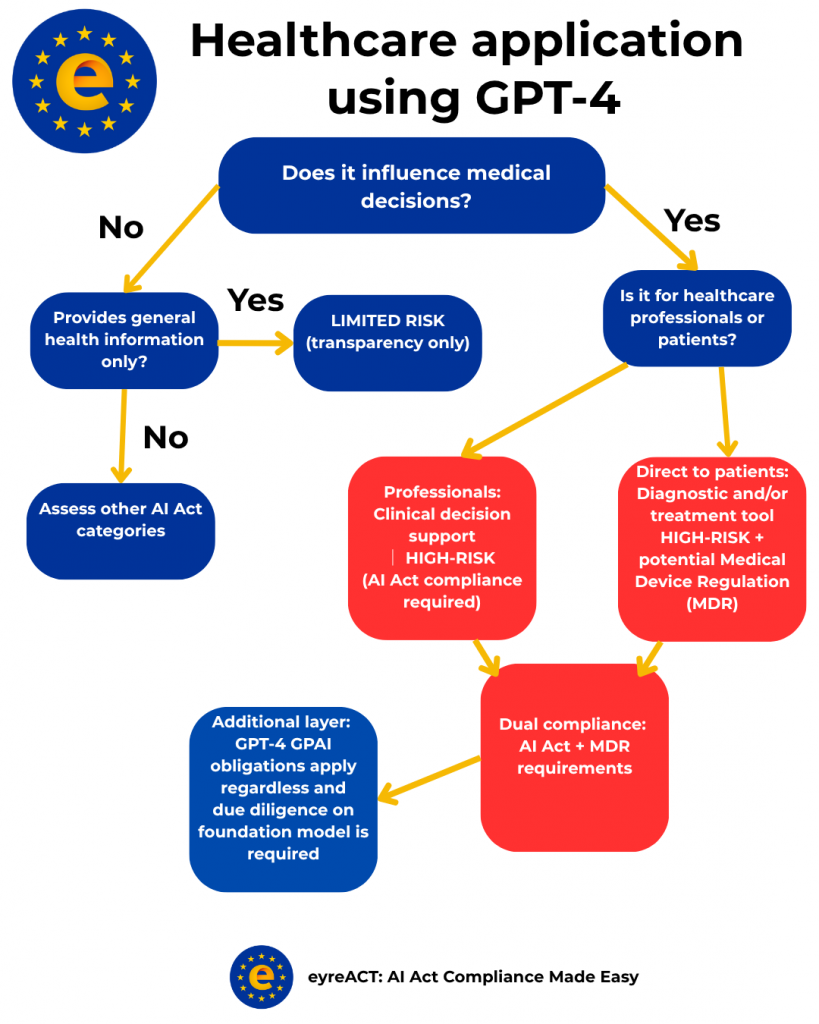
Visual: Healthcare AI Risk Categorization Flowchart
This decision flowchart shows how healthcare applications using GPT-4 are classified under EU AI Act, with three main paths leading to limited risk, high-risk, or high-risk plus medical device regulation depending on the application’s medical decision-making role.
Practical Mitigation Strategies
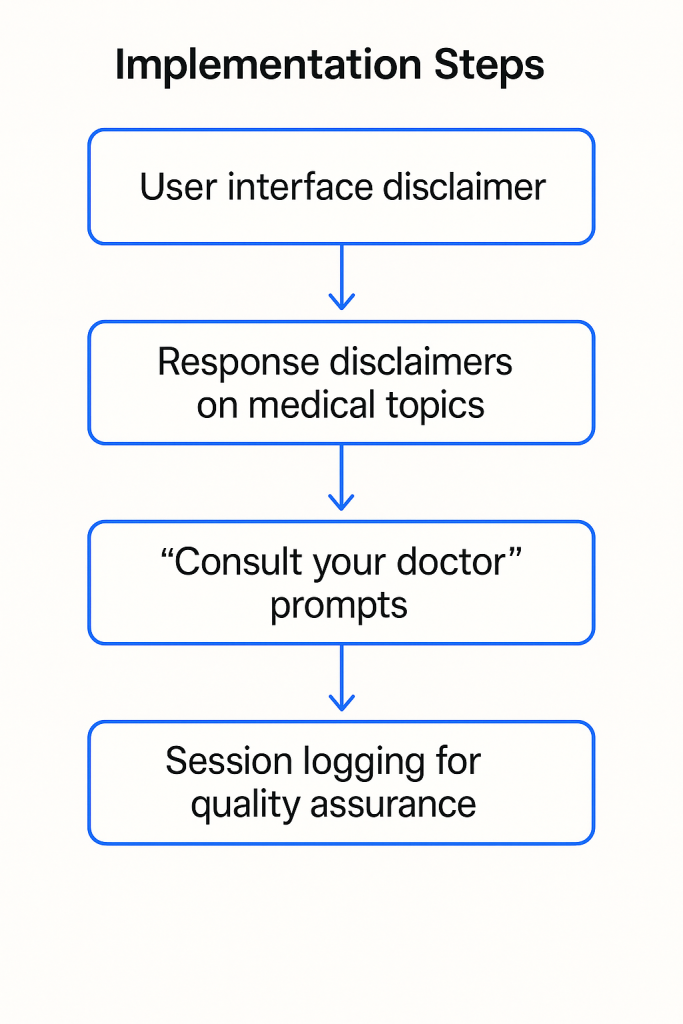
For Limited Risk Healthcare Chatbots
Required Actions:
- Transparency disclosure: “This system uses AI technology”
- Clear limitations: “Not a substitute for professional medical advice”
- Human oversight: Easy escalation to healthcare professionals.
For High-Risk Clinical Decision Support
Comprehensive Compliance Program:
1. Pre-Market Requirements
- Risk management system – Document potential medical risks and mitigation measures
- Clinical validation – Evidence that AI recommendations improve or maintain care quality
- Technical documentation – Model architecture, training data, performance metrics
- Conformity assessment – Internal or notified body evaluation
2. Foundation Model Due Diligence
- Model registry verification – Confirm GPT-4’s GPAI compliance status
- Capability assessment – Document model’s medical knowledge limitations
- Integration testing – Validate performance in your specific clinical context
- Bias evaluation – Test for demographic or clinical bias in medical recommendations
3. Post-Market Monitoring
- Incident reporting – Track AI-related medical incidents
- Performance monitoring – Ongoing accuracy and safety metrics
- Healthcare professional feedback – Systematic collection of user reports
- Model update management – Process for handling GPT-4 updates
Foundation Model Registry Requirements
Mini-definition: The EU AI Act requires providers of general-purpose AI models to maintain public registries documenting model capabilities, limitations, and safety measures.
Your Due Diligence Checklist:
 Verify OpenAI’s GPAI registration status
Review documented model limitations for medical use
Assess training data sources and potential medical bias
Understand incident reporting procedures
Document your risk assessment of the foundation model
When to Notify the EU AI Office
 CRITICAL NOTIFICATION REQUIREMENTS
Immediate Notification Required:
- Serious incidents: AI system causes or contributes to patient harm
- System malfunctions: Technical failures affecting medical decisions
- Security breaches: Unauthorized access to medical AI systems
Annual Reporting (High-Risk Systems):
- Performance metrics: Accuracy, safety, bias measurements
- Incident summaries: Aggregate data on AI-related issues
- System updates: Material changes to AI functionality
Timeline:
- Serious incidents: Within 15 days of becoming aware
- Annual reports: By January 31st each year
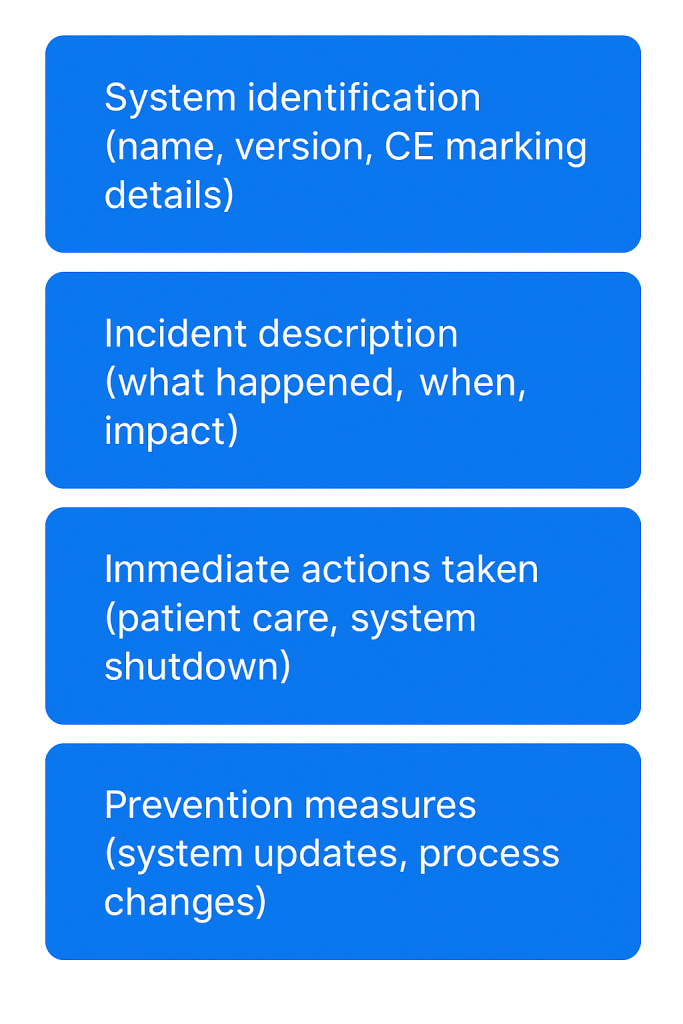
Notification Template Components
Real-World Implementation Example
Scenario: MedAssist Pro – Clinical decision support tool using GPT-4
System Description:
- Analyzes patient symptoms and medical history
- Suggests differential diagnoses to emergency room doctors
- Provides treatment protocol recommendations
Risk Classification: HIGH-RISK (Annex III healthcare application)
Compliance Requirements:
- Technical documentation (€50K-100K development cost)
- Clinical validation studies (6-12 months timeline)
- Conformity assessment (internal or notified body)
- CE marking before market placement
- EU database registration (public disclosure)
- Post-market surveillance (ongoing monitoring system)
GPT-4 Integration Considerations
- Model version control and update management
- Medical knowledge validation and bias testing
- Integration with clinical workflows and EHR systems
- Healthcare professional training and oversight
Total Compliance Investment: €200K-500K+ initial, €50K-100K annual
Turn AI Act compliance from a challenge into advantage
eyreACT is building the definitive EU AI Act compliance platform, designed by regulatory experts who understand the nuances of Articles 3, 6, and beyond. From automated AI system classification to ongoing risk monitoring, we’re creating the tools you need to confidently deploy AI within the regulatory framework.
Key Takeaways
The Bottom Line: Using GPT-4 in healthcare isn’t prohibited, but it requires dual-layer compliance—both for the foundation model integration and your specific healthcare application.
“Success with AI in healthcare isn’t about avoiding regulation—it’s about building compliance into your development process from day one.”
Essential First Steps:
- Define your exact use case – Medical information vs. clinical decision support
- Classify your risk level – Limited vs. high-risk application
- Assess foundation model compliance – Verify OpenAI’s GPAI obligations
- Plan your compliance timeline – High-risk systems need 12-18 months prep
- Budget for ongoing obligations – Post-market monitoring isn’t optional
Remember: The AI Act doesn’t ban AI in healthcare—it requires responsible implementation with appropriate safeguards. Start planning early, and consider the dual compliance burden from the beginning.
Next in Series: “Building AI Act-Compliant Clinical Decision Support: A Technical Implementation Guide”
This guide provides actionable compliance steps but should not be considered legal advice. Consult qualified legal counsel for your specific healthcare AI implementation.
Frequently Asked Questions (FAQ)
“Using foundation models like GPT-4 in healthcare creates a dual compliance challenge: the model itself may be regulated as a general-purpose AI system, while your healthcare application faces high-risk classification under the AI Act.” Julie Gabriel, legal lead, eyreACT. Using foundation models in regulated sectors brings layered compliance risk—you’re not just responsible for your application, […]
Ready to Start Your EU AI Act Compliance Journey?
Take our free 5-minute assessment to understand your compliance requirements and get a personalized roadmap.